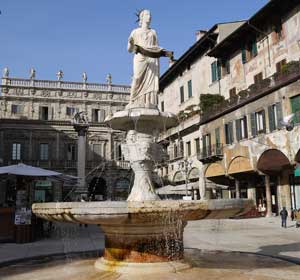
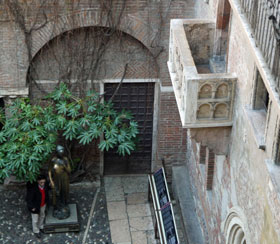
Verona, in the Veneto region of north-east Italy, is one of Italy’s loveliest towns, famous for its summer opera season. This has been a thriving and successful town for most of its history, and today smart shops and cafes fill the attractive medieval lanes of the historic centre. Verona is a popular day-trip from Lake Garda, and an appealing destination for weekend breaks or longer stays. There’s a lot to see here, from Roman ruins to the so-called ‘Juliet’s balcony’, and the town is also well-connected for exploring the surrounding area, including destinations like Lake Garda, Vicenza, Padua and Venice.
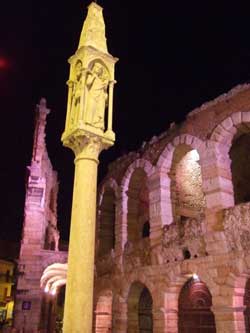
Verona was an important Roman town and is rich in archaeological sites, the grandest of which is the Roman Arena, where operas are now performed in the summer. It’s easy to spend a long time simply exploring the narrow streets lined with handsome palazzi that make up the historic centre. The town’s museums and churches contain fine works of art, while the ruined Roman theatre over the river has excellent views from the terraces where the ancients watched plays.
If you’re planning a longer stay, or want to see more of Italy, Verona is usefully located for travel to Venice or to lovely Lake Garda. There is a lot to see in this part of Italy, and it is easy to travel around by public transport. Combining Verona with another local destination (perhaps the lake) would make a great and varied two-centre holiday.
Things to see
Verona’s historic centre (centro storico) lies within the town walls in a tight curve of the Adige river. Entering town past the Porta Nuova gateway near the railway station, you head along wide car-filled Corso Porta Nuova before passing through the attractive fourteenth-century arches of the Portoni della Brà and entering the historic part of town. Immediately inside the town wall is Piazza Brà, a large open space dominated by the imposing Roman Arena. Verona’s tourist information office is nearby, set in the old town wall to the right. Via Mazzini, an elegant pedestrian street paved with shiny Verona marble, heads straight through the heart of town to Piazza Erbe, Verona’s most attractive square. It’s a good idea to have a map or guidebook at this point, and to dive into the pretty historic lanes uncovering Verona’s charms.
> More about Verona tourist attractions and sightseeing
The Romeo and Juliet trail
Shakespeare is extremely unlikely ever to have set foot in Verona. However, his source for the plot of Romeo and Juliet was derived at several removes from an Italian story set in the town, featuring two feuding families with names similar to those of historical Veronese dynasties. So there is a connection, but whether you wish to feel that the real town of Verona has any direct link to Shakespeare’s work is up to you. It doesn’t stop the town from marketing Romeo and Juliet postcards, mugs, tea-towels, sliding pens and more. There is a busy Shakespearian tourist trail, and (mind-bogglingly) you can post a letter to fictional dead character Juliet at ‘Juliet’s tomb’, or email her at ‘Juliet’s balcony’. The city organises various ‘romantic’ initiatives, including events around Valentine’s Day.
Travel to Verona
Verona is very easy to reach from other parts of Italy and Europe. It’s on a major railway line – with trains travelling as far as Paris – and the town has an international airport very close by, and several other airports within a couple of hours travel .
> Read about Verona Airport and transport links to and within the town
Eating and drinking
Verona’s two main hubs for sitting down with a drink or a light meal are Piazza Brà and Piazza Erbe. Of the two, Piazza Erbe has a much nicer atmosphere and you’ll find lots of locals at the appealing but somewhat pricey bars lining the square. Piazza Brà is more of a thoroughfare where you’ll pay a lot for a rather touristy experience. However, if you’re in a hurry or on a budget you’ll find two useful eating places here – speedy self-service restaurant Brek and the Italian fast food chain Spizzico.
For cheaper or more atmospheric meals, try wandering through the small lanes of the centro storico. Small restaurants and bars are scattered secretively through the centre – try spotting them at lunchtime when busy crowds of locals will indicate the best food. A wine bar will often serve a few cheap pasta dishes as well as a range of usually economical wines.
Restaurants
For a charming and authentic feel, join local workers in the cosy little Antica Osteria Al Duomo (Via Duomo, 7; closed Sundays), where you can eat good local dishes and enjoy cheap local wine. Another spot for an atmospheric meal is Piazza Erbe, the attractive market square. Along one side of the piazza is a row of cafe-bar-restaurants where you can sit at outside tables and enjoy a light meal or drinks. These establishments aren’t very cheap, but their tables occupy prime positions; it’s a lovely spot to sit on a sunny day and watch Verona go by.
For a cheap and filling meal, a good option is the Ristorante-Pizzeria San Matteo Church (Vicolo del Guasto, close to Porta Borsari), which, as its name indicates, is actually located in a former church. There are memorial tablets on the wall, a crypt displayed through glass floor panels, and dinner tables where the high altar would have stood. Locals come here in their lunch hour for a quick self-service meal, but there is also waiter service with a long and varied pizza menu as well as seafood alternatives.
Other good Verona restaurants include the Ristorante Sant’Eufemia (Via Emilei 21), close to the church of the same name. There’s a misleadingly off-putting multilingual menu outside but inside the restaurant is like the ground floor of a 19th-century mansion – you sit on fine old chairs – with a serious and secretive air, attentive service and good meals (including house wine) at a modest cost. Ristorante Tabià (Via Zambelli 14; closed Mondays), is a cheerful restaurant serving pizzas in a large, rustic-style interior. Osteria la Vecchia Fontanina (Piazzetta Chiavica, near Piazza Erbe) is is a welcoming and atmospheric place to eat in a central location.
Verona accommodation
Verona has some good central hotels, but it’s not a cheap place to stay and it is worth booking in advance. My Verona hotel selection includes an excellent, reliable four-star, some budget options and one or two really special, romantic places to stay.
> See a selection of the best places to stay in Verona
Useful external links
Veneto destinations
- Veneto region
- Abano Terme
- Asolo
- Bassano del Grappa
- Brenta Canal
- Caorle
- Castelfranco Veneto
- Chioggia
- Cittadella
- Concordia Sagittaria
- Conegliano
- Cortina d’Ampezzo
- Lido di Jesolo
- Malcesine
- Marostica
- Monselice
- Montegrotto Terme
- Padua
- Portogruaro
- Rovigo
- Sottomarina
- Treviso
- Venetian Lagoon
- Venice
- Verona
- Vicenza
- Veneto art & architecture itinerary
- Veneto villas – Vicenza: La Rotonda & Villa Valmarana ai Nani
- Veneto villas – Villa Pisani & Villa Foscarini Rossi, Strà
- Venice Airport
- Treviso Airport