About Vicenza
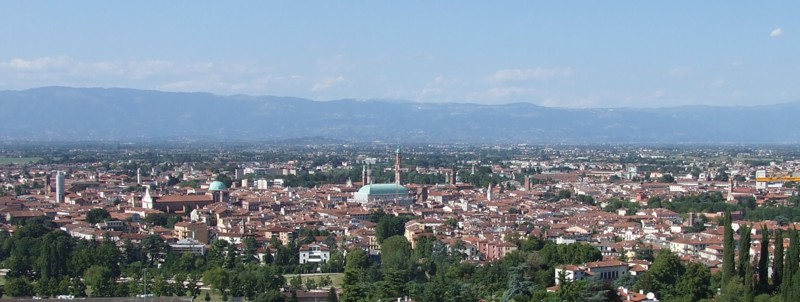
Vicenza is located in the Veneto region of Italy, in its own province (the Provincia di Vicenza). It’s a medium-sized town, with a population of 110,000. There has been a settlement here right back into the depths of history; remains of the Roman town can still be seen. Later, after the barbarian invasions which repeatedly devastated this part of Italy, it became a significant town, ruled at different times by various greater powers. For several centuries it was governed by Venice; then Napoleon, then the Austrians. In 1866 it became part of the new Kingdom of Italy.
Vicenza was a prosperous town under Venetian rule, and its pride was demonstrated in fine architecture, much of which still survives. Its ‘unique appearance,’ largely owing to the work of influential sixteenth-century architect Andrea Palladio, has led to the town’s designation as a UNESCO World Heritage Site: City of Vicenza and the Palladian Villas of the Veneto. After Palladio, Vicenza is most famous for its trade in precious metals, it’s also known as the ‘City of gold’.
It’s a lovely town to visit; with a beautiful, compact town centre and attractive villas and viewpoints in the hills a short walk away.
> Villa excursion
Visiting Vicenza
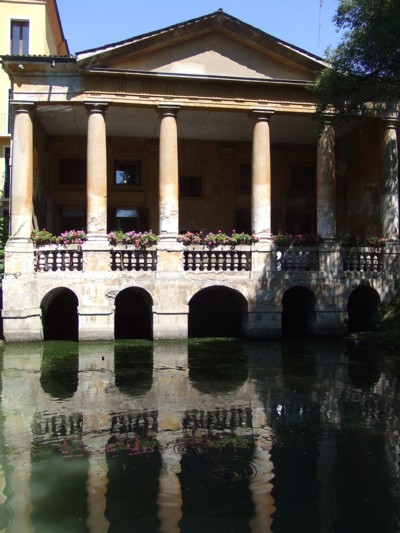
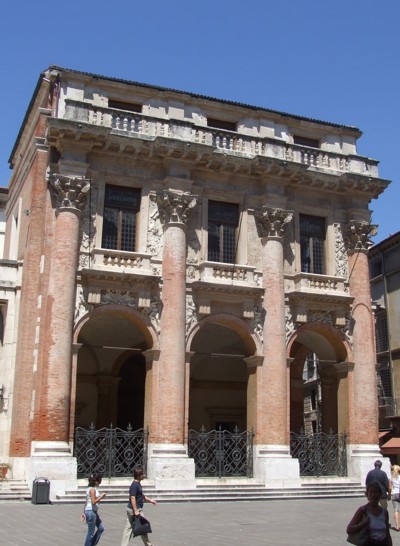
The railway station is to the south-west of the town centre; most of Vicenza’s attractions are clustered closely together inside the old town walls. Walking straight along Viale Roma from the railway station, you’ll pass two bus stops for the number 8 – if you are planning a trip to the villas just outside town, check the latest timetable displayed here. Soon you’ll arrive outside the old town gate, Porta Castello, but first you can visit the Giardino Salvi just outside the gateway: a shady park, ornamented with statues and the Palladian Loggia Valmarana, which is dramatically reflected in dark waters.
Just inside the gateway lies a very convenient self-service restaurant, Self Pause, which is a cheap and quick place to fill up before exploring the town centre. Around Vicenza you can admire many grand buildings by Palladio and his followers. The Italian word palazzo usually means any large building rather than a palace; but many of Vicenza’s palazzi do merit the grander translation. Some of the town’s buildings are medieval, with several in the Venetian Gothic style, but the majority date from the sixteenth and seventeenth centuries. They line the narrow lanes of Vicenza’s town centre; which are called contra, a local word for ‘street’.
As soon as you’re inside the Porta you find yourself among the town’s great buildings. One of the most curious is off to your right. Designed by Palladio, Palazzo Porto Breganze was never finished and stands in an abbreviated form. In front of you is the Corso Andrea Palladio, the centre’s main thoroughfare, lined with smart shops and cafes. Some of Vicenza’s grandest palazzi lie on Contra Porti, off to the left.
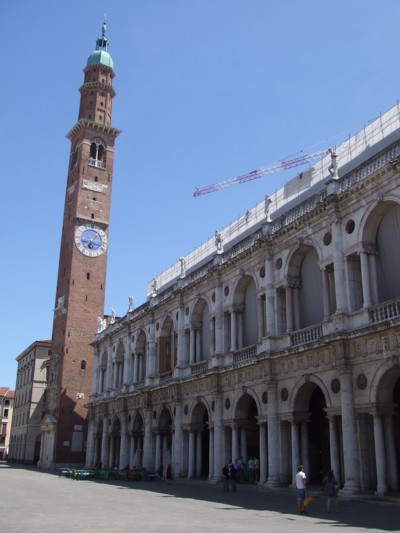
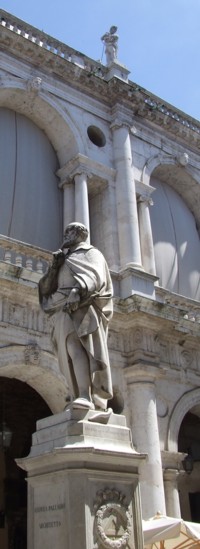
Piazza dei Signori, a few yards south of Corso Andrea Palladio, is the heart of town. It is dominated by two of Vicenza’s most striking landmarks, the Basilica Palladiana, the town’s medieval law courts, with an imposing later facade by Palladio, and the adjacent Torre di Piazza, a tall and skinny tower. Right in the long midday shadow cast by the tower you’ll find one of Vicenza’s tourist information offices, where you can pick up a town map, leaflets about local events and attractions and any advice you may need. A second office is located not far away, by the Teatro Olimpico.
The town’s most famous individual sight is the Teatro Olimpico, Palladio’s last work, which was finished by his son and then by Vincenzo Scamozzi. The ticket you’ll buy here (8) entitles you to enter the town’s various civic museums. Conveniently, the theatre is open throughout the day with no lunchtime closure. The building was modelled on ancient Roman theatres, with a curved amphitheatre, graded stepped seating and lavish ornamentation. It incorporates a fabulous permanent stage set (designed for Greek tragedy) by Scamozzi with trompe l’oeil street scenes and classical motifs.
Over the road from the Teatro Olimpico is Palazzo Chiericati, which today houses the town’s museum (Museo Civico) and art gallery (closed Mondays, lunchtimes and also Sundays in winter). The collections here are fairly interesting; art lovers should also pay a visit to the Gothic Church of Santa Corona to see works by Giovanni Bellini and Paolo Veronese.
The Palladio links have inspired an architecture study centre and museum, the Centro Internazionale di Studi di Architettura Andrea Palladio, which houses architecture exhibitions in a palazzo designed by Palladio, Palazzo Barbaran da Porto.
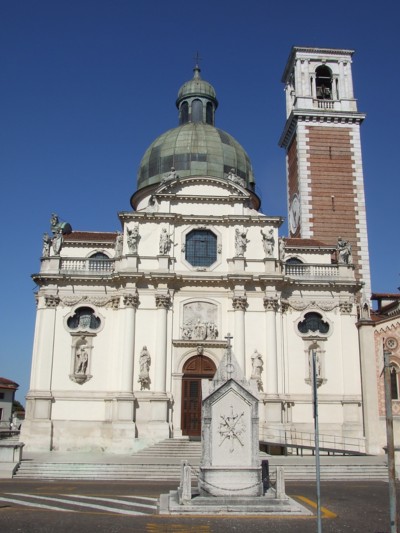
For views over the area, visitors can walk uphill (or take a bus) to the Santuario di Monte Berico, a church built on the site of two apparitions of the Madonna. A long arcaded walkway climbs up the hill, which is useful on a sunny or a rainy day.
Vicenza transport
The most convenient airports for Vicenza are Treviso Airport, Venice Marco Polo and Verona. If you’re arriving from Marco Polo Airport, take a connecting bus to Mestre (the Venice mainland station) where you can pick up the train.
Vicenza can be reached in 45 minutes from Venice by taking one of the faster and most expensive trains; a cheaper option will take just over an hour. Padua is 20 minutes away by rail. Coming from Treviso, travellers will sometimes have to change at Mestre, although there are also direct ‘stopping’ trains; either way, the journey will take you just over an hour. The rail journey from Verona takes between 25 and 45 minutes, again depending on the category of train. Vicenza and its surrounding area are served by local buses, although you’ll be able to sightsee on foot in the city centre.
Things to do around Vicenza
Vicenza is connected by rail to Venice, Padua and Verona for easy daytrips. It’s a good central base for exploring the Veneto region, from Lake Garda in the west to Treviso and Venice in the east – this is particularly easy if you have a hire-car. Rail and bus services do cover the area, though, so you can still manage a lot of exploring using public transport.
The elegant villas around Vicenza would make the area worth visiting even without the town. Several were designed by Andrea Palladio, but there are plenty of others to be visited. Among the most well-known is the Villa Valmarana ai Nani (‘of the dwarves’), so-called because of its decorative statues. Nearby is Palladio’s famous villa, La Rotonda. Both of these are in the outskirts of Vicenza and can be reached by bus number 8. They can be combined in a walking excursion with Monte Berico – read directions in our Vicenza villas article.
Further from town you’ll find a good assortment of villas which are open to the public. Pick up maps and check the latest opening times at the tourist information office before you set off, as many have limited visiting hours. Hiring a car will make exploring much easier, but with careful planning – and allowing more time – you can manage some interesting day trips by bus.
> Book a hotel or B&B in Vicenza
On this site
Vicenza villas – an afternoon excursion
Veneto art & architecture itinerary
Useful external links