Focus on Capri
1. Introduction
2. Best of Capri
3. Capri town
4. Anacapri
5. Capri hotels
6. Anacapri hotels
7. Hotel ‘A Paziella
8. Hotel Weber Ambassador
Capri hotel, tourist and travel guide
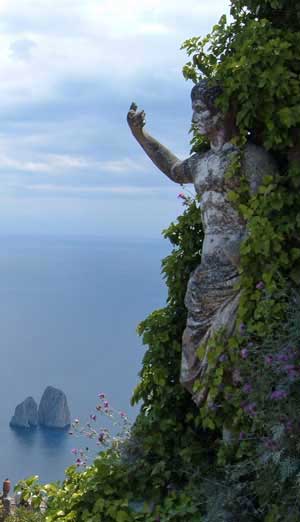
The Isle of Capri is famed as a classy and beautiful holiday destination. It’s an island of myths, ranging through sirens charming seafarers, ancient Roman orgies, dreamy seaviews, 1950s celebrities in big sunglasses, and lazy summer evenings spent browsing in exclusive boutiques alongside the world’s elite.
Capri is an island of many contrasts. For rushed daytrippers, it is a crowded maze of expensive boutiques. For celebrities and the ultra-rich, a point of rendezvous. For historians, it is the palace-island of the Emperor Tiberius, dotted with neglected Roman remains. Walkers can step out along scenic short walks. For leisurely holidaymakers, it can present all this and more, along with staggering views and blue, blue sea. It is a dream honeymoon destination.
About Capri
Capri is a rocky island off the shores of the southern Italian region of Campania. It lies at the southern edge of the Bay of Naples, beyond the Sorrentine peninsula (where you’ll find mainland Sorrento and the Amalfi Coast). English people generally mispronounce the name of the island – it’s not C’pree as in Ford, but CAPri, with the stress on the first syllable.
Capri tourist attractions and holiday information
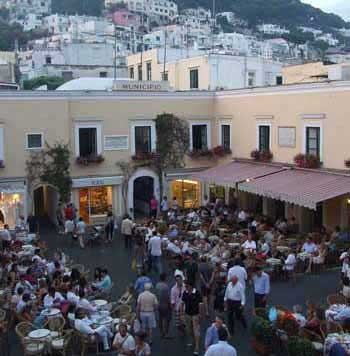
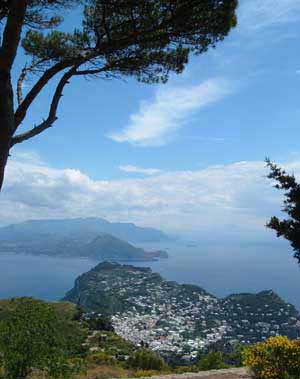
Capri is an island which some people love and some people hate. You will usually find that the island’s critics haven’t given it a fair chance: they’ve arrived for a brief day trip, and found an expensive commercialised destination crammed to bursting with other daytrippers. Others, however, love the combination of island simplicity, natural beauty and busy glitz. And if you stay overnight, you’ll find a different Capri. After the last daytrippers leave, a kind of exclusive peace settles over the island as those who are privileged to be staying overnight emerge for their evening passeggiata, or to sip drinks on the famous little square, the Piazzetta.
There are two towns on Capri; Capri town itself, which is in the centre of the island, and is where most of the hotels are located, and Anacapri. Anacapri is situated on a plateau above Capri, and is a quieter, more ‘normal’ town. Accommodation is generally cheaper, although you’re still not far from the hub of things, and there is a regular bus service. From Anacapri you can take the chairlift up to the top of Monte Solaro and enjoy the views before the trip back down (on foot if you’re so inclined). Villa San Michele, the home of Swedish doctor and writer Axel Munthe (see book section below) is located in Anacapri, and is open to the public.
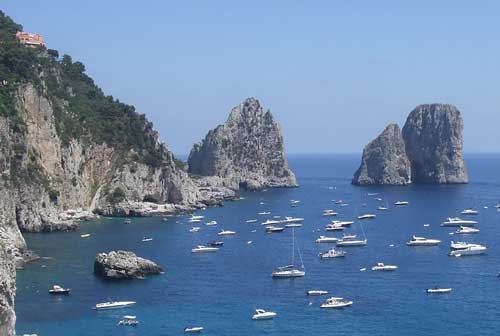
The principal Capri tourist attraction is the island itself; its views, its rocky seashores and its scenic charm. There is plenty of good walking – or strolling – to be done as you explore the island. Top scenic panoramas include views of the Bay of Naples, the Faraglioni Rocks and the Gardens of Augustus. At the ruined Villa Jovis you can see the remains of the Emperor Tiberius’s palace, and also the cliffs over which he is reputed to have had his enemies tossed. Back in Capri town, the 14th-century Certosa di San Giacomo is a handsome old monastery-fortress, now hosting a school and art exhibitions. For shopaholics, Capri town is a dream, with all the big designer names and expensive boutiques. Almost every Capri visitor makes the trip to the Grotta Azzurra, the Blue Grotto. Like the island itself, it tends to split its visitors in two – those who find the blue-lit cave an unforgettable experience, and those who find the jostling boatsmen and extortionate prices a rip-off. A boat trip around the island, though, is a more rewarding experience. You can admire the coastline and the island’s other grottoes in a leisurely fashion.
Visitors should note that Capri is not an ideal beach destination. The island is steep and rocky, with the main settlements high above sea level. There are just a couple of small shingle beaches. On these beaches, and on a few rocky shores, there are bathing establishments where you pay for the use of sunbeds. Apart from swimming pools, most swimming is in deep water off rocky coastlines, so is only advisable for confident swimmers.
Capri history
The privileged and talked-about have been coming to Capri for two thousand years. The Emperor Augustus took a fancy to it, and swapped it for his island of Ischia, and his successor Tiberius made it his home when Rome became too hot to hold him. By all accounts he had a good time on Capri; if his Roman biographers are to be believed, he got up to all sorts of scandalous behaviour on the beautiful island. You can still visit the ruins of his villas, and appreciate the spell that charmed the Emperors.
Later, and presumably better-behaved, inhabitants were the monks who built the Certosa in an attempt to defend the island from invading Saracens. The Romantics and Grand Tourists later admired the island’s rocky natural beauty, while the French occupied Anacapri and fought the English here during the Napoleonic wars.
In 1826 the Grotta Azzurra was ‘discovered’ by a German tourist, the poet August Kopisch, and gradually the island became established as a desirable holiday haunt for artists, writers, royalty and celebrities, a status it still holds today. The port at Marina Grande was built in the twentieth century and enabled visitor numbers to rise as tourism became the island’s chief industry.
Capri travel information
Get to Capri
Regular ferries run to Capri from Naples and Sorrento. In Naples, ferries and hydrofoils embark from Molo Beverello (near Piazza Municipio) and Molo Mergellina (near the railway station of the same name). Journey time is approximately 40 minutes with a hydrofoil and 1hr 20 mins with a ferry. Molo Beverello is the principal port for passenger services, and it is connected with Naples Capodichino Airport and the railway station by a direct bus service, called Alibus. When you arrive at the port, check the departures board to see which company is operating the next fast service, then queue at the ticket kiosk for that company. The trip from Sorrento is shorter, and there are plenty of crossings a day to cater for daytrippers. There are additional seasonal ferry services from the Amalfi Coast, calling at Positano and Amalfi.
Get around Capri
Capri ferries arrive at the port of Marina Grande. From Marina Grande, the best way up to Capri town is by funicular. Buy transport tickets at a kiosk on the right as you come ashore, then catch the funicular on your left – it’s unobrusively housed in a row of buildings. There are also small buses running up to Capri town and Anacapri. If you don’t fancy lugging your suitcases around, you can hand them over to a porter who will deliver them to your hotel for a fee (many hotels will arrange a porter service for you). Buses travel busily around the island, connecting Capri, Anacapri, Marina Grande, the Grotta Azzurra, Faro and Marina Piccola. At the ticket kiosks in Marina Grande and Capri you can buy tickets for buses and the funicular, valid for a single journey, an hour or a day. Sightseeing boats also circle around the coastline. Capri’s two towns are highly walkable so you may not bother too much about public transport once you’re there.
Guides to Capri and Capri must-reads
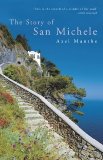
The Story of San Michele by Axel Munthe
First published in the 1920s, this eccentric book has a devoted following, and comprises the memoirs and fanciful musings of a Swedish physician who made Capri his home. San Michele, the home he created and filled with art and artefacts, is one of the island’s big tourist attractions. His book is a good preparation for exploring Capri – and is a popular purchase for this website’s visitors.
> The Story of San Michele

I Love Capri by Belinda Jones
Escapism in the ‘citrus-coloured’ girly genre. The heroine leaves her flat in Cardiff and finds herself on sunny, glamorous Capri, being pursued by charming Italian men. Lightweight fun, but very good at scene-setting and the book will add to the anticipation before your visit – or make for good reading as you sun yourself by the pool. Incidentally, the novel’s main characters reappear very briefly in Belinda Jones’s later novel set in Venice The Love Academy.
> I Love Capri

Sorrento, Amalfi Coast and Capri
This popular book, published by Sunflower Books, is probably the best specialist guidebook you’ll find for the area. Especially good for walkers, it includes recommended walks (and strolls) in the Amalfi Coast and Sorrento area, with practical information about public transport. There are several carefully-described walks on Capri, which are a good way to see more of the island.
> Sorrento, Amalfi Coast and Capri (Landscapes)
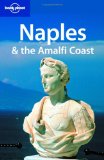
Lonely Planet: Naples and the Amalfi Coast
This has 15 pages on Capri, with knowledgeable descriptions and advice. It includes brief walk recommendations and listings of attractions, hotels and restaurants.
> Naples and the Amalfi Coast (Lonely Planet City Guides)
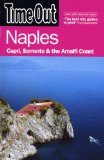
Time Out Guide to Naples, Capri, Sorrento and the Amalfi Coast
The Time Out Guides always give good advice on places to visit, places to shop and place to eat and drink. Their Naples guide also includes Capri and the Amalfi Coast, so it may be a worthwhile purchase, especially if you are spending time in Naples too. The cover of the latest edition show’s Capri’s coastline.
> “Time Out” Naples
> Buy from Amazon.com
> Read on: Best of Capri – my top things to do on the island
> Selected Capri hotels
On this site
Best of Capri – our favourite things to do
Hotel Weber Ambassador – our review
Hotel ‘A Paziella – our review
Capri town hotels – our selection
Useful links