> Siracusa
> Tourist attractions
> Exploring Ortigia
> Siracusa hotels
> Castello Eurialo
> Around Siracusa
Siracusa tourist attractions part 1: Mainland
The majority of Siracusa’s fine sights are archaeological and historical, bearing witness to the grand past of this Sicilian town. The attractive historic centre on the island of Ortigia is a good place to stroll, shop and eat, but for the main monuments you’ll need to head ashore.
- Sicily destinations and practicalities: full menu (at foot of this page)
The island of Ortigia is the hub of tourist Siracusa, but Greek Syracuse covered a large area inland, and many of the finest archaeological sights are to be found in the less built-up area around the archaeological park, or among the modern streets.
> Find a hotel or B&B in Siracusa
> Siracusa travel and practical information
Siracusa is a large town including island and mainland districts, and a map from your hotel or the tourist information office will be very helpful. In my experience Siracusa’s tourist attractions offer very little in terms of information, context or guides. If you are particularly interested in the historical background, I’d suggest taking a detailed guidebook, printing some background information in advance, or even paying a private tour guide to make sure you get the most from the historic sights.
Note that Siracusa’s attractions (except the archaeological park and museum) usually close for lunch. Some close on Mondays, some at weekends, and sometimes in the afternoon, as well as varying their hours throughout the year. Check the latest opening times with the tourist office on your arrival in town to avoid disappointment.You can buy joint tickets for the archaeological park and the archaeological museum. These sights, and the art gallery at Palazzo Bellomo, are expensive but offer the usual state-museum reductions.
Archaeological zone: Neapolis
The city’s finest sight is its superb Archaeological Park of Neapolis, which includes a range of monuments in its limits, with more to be seen just outside (don’t miss the vast Altar of Hieron, which can be seen from the little approach road). Tickets are purchased in a separate building, past a row of gaudy souvenir stalls and toilets (no need to use these fee-paying ones though, as there are free facilities inside the archaeological park). The park is open daily, and is on Viale Paradiso.
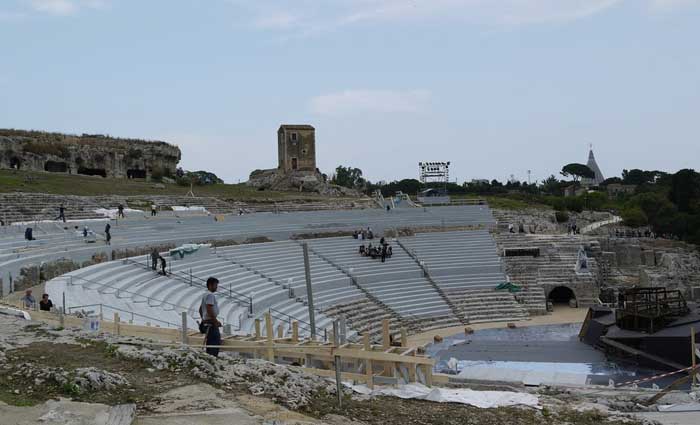
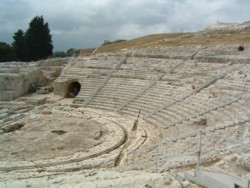
Siracusa’s Greek theatre (Teatro Greco) is one of the finest and largest of its kind. Cut directly into the rock, it was enlarged and modified several times over the centuries, and is still in use today – Greek plays are performed here in May and June each year (note that if you visit around this time you will find the theatre disfigured with wooden seating and stage sets).
Up above the Greek theatre is a low cliff with several caves cut into it, including a nymphaeum, where statues once surrounded the water feature.
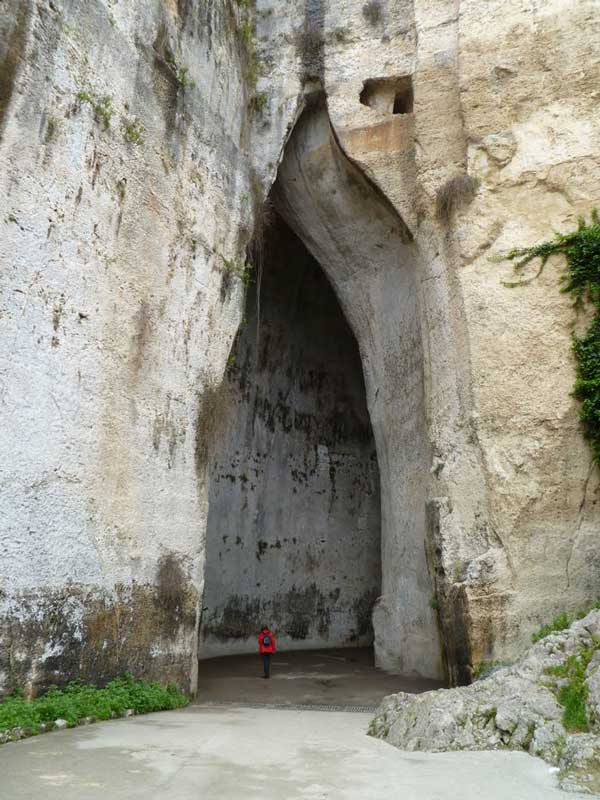
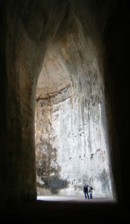
The deep quarry to the east of the theatre is called the Latomia del Paradiso (Paradise Quarry), and it’s a peaceful and green spot, filled with vegatation and lemon trees. The most famous sight here is the huge cave called the Ear of Dionysius (Orecchio di Dionisio). Apparently it was Caravaggio who coined the name; the connection with Dionysius is the story that this ruler of ancient Syracuse used to eavesdrop on his prisoners incarcerated here, thanks to the cave’s acoustics. A second cave nearby, the Grotta dei Cordari was used by the ropemakers who gave the place its name.
Further along past the quarry – you’ll need to leave the archaeological park and follow Via Romagnoli around – are more quarries and a dramatic necropolis, with burial-niches cut into the rock – the most grand of these was traditionally supposed to be the burial place of Archimedes.
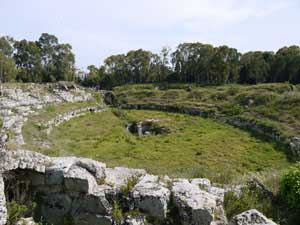
Outside the main park, but included in the ticket, is the Roman Amphitheatre (Anfiteatro Romano), a wonderfully evocative spot, more so because unlike the Greek theatre, this is overgrown, covered in flowers and often overlooked by the tour parties.
Once outside the park area, if you head back behind the stage of the Greek theatre, past a restaurant, and turn right up a hillside road (about 5 minutes walk) you’ll see a smaller Roman theatre, the Teatro Lineare. There’s not a huge amount left to see, but it’s an interesting contrast to the grander curved Greek theatre.
Museo Archeologico Regionale ‘Paolo Orsi’
Named after a prominent archaeologist who was responsible for many important excavations, Siracusa’s archaeological museum has a fine and extensive collection. It’s divided into four sections the first of which, section A, covers Sicily before the Greeks, from fossilised dwarf elephants to Bronze Age grave goods. This section alone is worth the cost of admission – if you have the time to spare, you can learn lots of fascinating information about Sicily’s earliest inhabitants, their lifestyles, burial rituals, and trade in precious items. Highlights include an ancient perforated vessel for draining food, little strainer vases like early teapots, and pottery decorated with birds from around the 15-13th centuries BC. The section includes gigantic pots from burials, along with photos and descriptions of the big burial sites – hills honeycombed with cave tombs. The next sections, B, C and D, progress through the Greek and Hellenistic eras and up to Roman times. These later sections include artistic masterpieces such as the statue of Venus Anadyomene/Landolina (a Roman copy of a Greek original), as well as great chunks of temple facade, lion waterspouts from the Temple of Athena (now Siracusa’s Duomo) and row upon row of votive offerings. The Greek and Roman exhibits come mostly from the Siracusa area, and from Megara Hyblea, along the coast.
Easier to deal with than many Italian museums, the purpose-built Museo nevertheless suffers from misapplication (or exhaustion?) of funding, with disinterested staff and a lack of general information. A planned, cordoned route through each section takes you past every single exhibit – frustrating for those with a short attention span, but helpful to the thorough tourist. If you are in a real hurry, you could head from the museum’s central circular hall to whichever section interests you the most. Many of the information labels have English translations. You’ll need to allow a couple of hours for the museum, or even more if you want to read all of the detailed information boards. The museum is just down the road from the archaeological site, at Viale Teocrito 66. Closed Mondays, and Sunday/public holiday afternoons.
More mainland Siracusa tourist sights
Inland, there are several sights of interest worth seeking out among the more modern streets.
Catacombs of San Giovanni
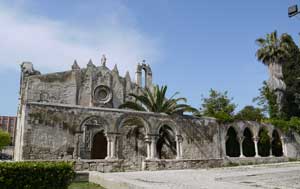
The Catacombs of San Giovanni (close to the archaeological museum) were created as a cemetery for Siracusa’s substantial Christian community. They were built when Christians were no longer persecuted, so there was no need for secrecy and the tunnels are less cramped and claustrophobic than earlier specimens, such as the immense catacombs of Rome. Much of the structure was built out of an earlier water system, and the underground aquaduct (two metres wide and high, acting as a central corridor), and the three big cisterns on the tour (each the size of a large room, with a well-opening above), are themselves interesting.
There are supposedly 10,000 burials here, utilising different kinds of tomb, from small niches to elegant arched chambers. A guided tour takes you around the tunnels and points out interesting spots, such as traces of painting – some of the tours are in English, but you may have to wait or return later in the day for one of these. The 40-minute tour includes the lovely ruined church of San Giovanni – in the summer, weddings still take place in the charming garden-nave, open to the sky. Beneath the church is the Crypt of San Marciano (St. Marcian – the first bishop of Siracusa), which is one of the most interesting spots on the tour. A very early rock-cut church, it retains a few ancient bits of fresco and a slab on which St Paul is reputed to have rested during a stay in Syracuse.
There are several sets of catacombs in Siracusa, with this one open to the public regularly, while another, under the Church of Santa Lucia (see below), has been open at times. A third set of catacombs is open only by appointment.
Latomia dei Cappuccini
After the the city’s famous victory over a Greek navy sent from Athens, Syracuse’s prisoners of war were packed into quarries and left to starve to death. The quarries at Neapolis are atmospheric, but to see the Latomia dei Capuccini, where this unpleasant incarceration is said to have taken place, you’ll need to walk or catch a bus out to the end of the Riviera Dionisio il Grande. The quarry-garden is open to the public on Monday-Friday mornings, and is a very atmospheric place to visit. As well as a quarry-cum-slave camp and prison, it has also been used as an early Christian meeting and burial site, monastery garden, citrus grove, pleasure ground (there are two twentieth-century open-air theatres) and now off-the-beaten-track tourist attraction.
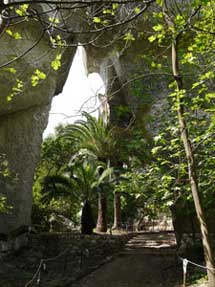
The Latomia entrance is to the right of a church, just over the road from a pleasant viewpoint by a war memorial, with views along the coast and over Ortigia. The belvedere is a popular spot with locals; there’s a kiosk bar serving refreshing freshly-squeezed orange juice, and alongside is the start of an ‘eco-route’ which follows the course of an old railway line along the cliffs for 6km, busy with joggers, walkers and cyclists. Just down the hill towards the town centre is the Jonico restaurant, which has attractive panoramic terraces.
Basilica di Santa Lucia
Standing at one end of a picturesquely long and dusty piazza, the Basilica di Santa Lucia is dedicated to Siracusa’s patron saint. There are extensive catacombs under the church. This church was the home of the Caravaggio painting The Burial of Santa Lucia, which in recent years has been shifted around Siracusa from one location to another, but is worth tracking down during your visit.
Santuario della Madonna delle Lacrime
Siracusa’s modern pride is the unusual Santuario della Madonna delle Lacrime, a huge church which is supposed to resemble a teardrop, and which makes a good landmark when navigating your way around town. The church commemorates a small icon of the Madonna which purportedly began weeping tears in 1953.
Other archaeological sites
More relics of ancient Siracusa include the Greek Arsenal, (on Via dell’Arsenale), where blocks of stone are all that’s left of the naval base. The Ginnasio Romano, actually a Roman theatre, can be seen on Via Elorina, and a fenced-off area of the pleasant Foro Siracusano park contains some columns to admire. Ruins of the Greek and Roman eras can also been seen exposed in front of the Santuario della Madonna delle Lacrime, in Piazza della Vittoria. Outside town, reachable by urban buses, is one of the finest ruins of all: the extensive remains of an ancient Greek fortress, Castello Eurialo.
> Read on: the island of Ortigia.
Useful external links
Siracusa council – for opening times
Siracusa catacombs & guided tours
Siracusa Hotels
My selection of the best (and the best value) Siracusa hotels and B&Bs, with reviews and online booking.